DEVELOPMENT
Partnering with Nintendo in 1998, ArtX began the complete design of the system logic and of the graphics processor (codenamed "Flipper") of Nintendo's sixth-generation video game console. The console project had a succession of codenames: N2000, Star Cube, and Nintendo Advance. At Nintendo's press conference in May 1999, the console was first publicly announced as "Project Dolphin", the successor to the Nintendo 64. Subsequently, Nintendo began providing development kits to game developers such as Rare and Retro Studios. Nintendo also formed a strategic partnership with IBM, who created the Dolphin's CPU, named "Gekko".
GameCube Devkit
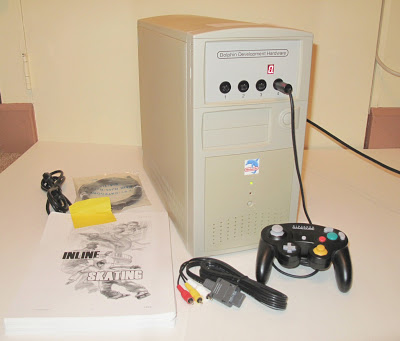
ArtX was acquired by ATI in April 2000, whereupon the Flipper graphics processor design had already been mostly completed by ArtX and was not overtly influenced by ATI. In total, ArtX team cofounder Greg Buchner recalled that their portion of the console's hardware design timeline had arced from inception in 1998 to completion in 2000. Of ATI's acquisition of ArtX, an ATI spokesperson said, "ATI now becomes a major supplier to the game console market via Nintendo. The Dolphin platform is reputed to be king of the hill in terms of graphics and video performance with 128-bit architecture."
The console was announced as the GameCube at a press conference in Japan on August 25, 2000, abbreviated as "NGC" in Japan and "GCN" in North America. Nintendo unveiled its software lineup for the sixth-generation console at E3 2001, focusing on fifteen launch games, including Luigi's Mansion and Star Wars Rogue Squadron II: Rogue Leader. Several games originally scheduled to launch with the console were delayed. It is also the first Nintendo console since the Famicom not to accompany a Super Mario platform game at launch.
Long before the console's launch, Nintendo had developed and patented an early prototype of motion controls for the GameCube, with which developer Factor 5 had experimented for its launch games. An interview quoted Greg Thomas, Sega of America's VP of Development as saying, "What does worry me is Dolphin's sensory controllers [which are rumored to include microphones and headphone jacks] because there's an example of someone thinking about something different." These motion control concepts would not be deployed to consumers for several years, until the Wii Remote.
Prior to the GameCube's release, Nintendo focused resources on the launch of the Game Boy Advance, a handheld game console and successor to the original Game Boy and Game Boy Color. As a result, several games originally destined for the Nintendo 64 console were postponed in favor of becoming early releases on the GameCube. The last first-party game in 2001 for the Nintendo 64 was released in May, a month before the Game Boy Advance's launch and six months before the GameCube's, emphasizing the company's shift in resources. Concurrently, Nintendo was developing software for the GameCube which would provision future connectivity between it and the Game Boy Advance. Certain games, such as The Legend of Zelda: Four Swords Adventures and Final Fantasy Crystal Chronicles, can use the handheld as a secondary screen and controller when connected to the console via a link cable.
Nintendo began its marketing campaign with the catchphrase "The Nintendo Difference" at its E3 2001 reveal. The goal was to distinguish itself from the competition as an entertainment company. Later advertisements have the slogan, "Born to Play", and game ads feature a rotating cube animation that morphs into a GameCube logo and ends with a voice whispering, "GameCube". On May 21, 2001, the console's launch price of $199 USD was announced, $100 USD lower than that of the PlayStation 2 and Xbox.
GameCube reveal, E3 2001
RELEASE
The GameCube was launched in Japan on September 14, 2001. Approximately 500,000 units were shipped in time to retailers. The console was scheduled to launch two months later in North America on November 5, 2001, but the date was pushed back in an effort to increase the number of available units. The console eventually launched in North America on November 18, 2001, with over 700,000 units shipped to the region. Other regions followed suit the following year beginning with Europe in the second quarter of 2002.
On April 22, 2002, veteran third party Nintendo console developer Factor 5 announced its 3D audio software development kit titled MusyX. In collaboration with Dolby Laboratories, MusyX provides motion-based surround sound encoded as Dolby Pro Logic II.
The Triforce arcade board is a joint development between Nintendo, Namco, and Sega, based on the Gamecube's design. Its games include Mario Kart Arcade GP and F-Zero AX.